
2000
for
string quartet
David Schober

Miró Quartet
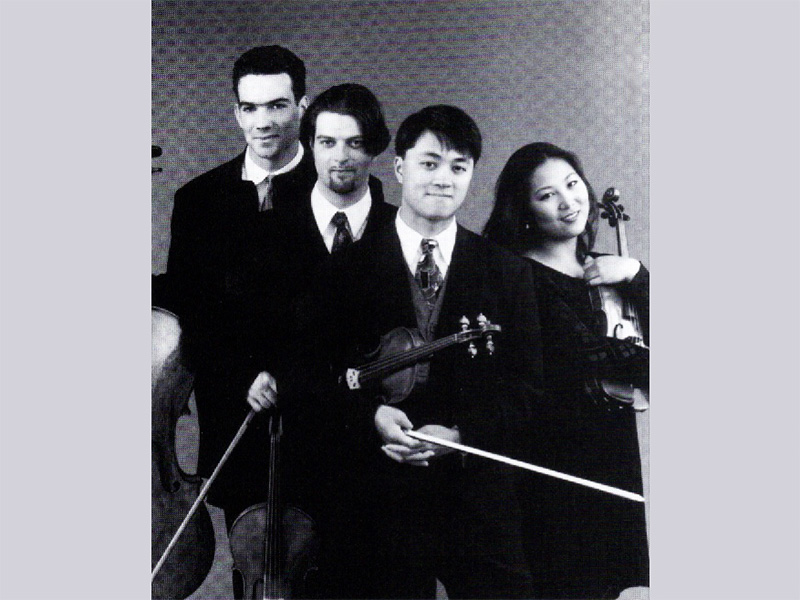
2000 Chamber Music Competition

March 26, 2001

David Schober is a composer, pianist, and music theorist who teaches at Queens College's Aaron Copland School of Music. He studied at Oberlin, the University of Michigan, and Yonsei University. His commissions include works for the Minnesota Orchestra and the Miró Quartet, supported by the Naumburg Foundation.
Schober’s quartet responds to Joan Miró’s paintings through restless textures, rhythmic energy, proportioned sections and a brief finale suggesting perpetual motion.

Composer, music theorist, and pianist David Schober studied at the Oberlin Conservatory, the University of Michigan, and Yonsei University in South Korea. Recognition for his composition work includes a Charles Ives Scholarship from the American Academy of Arts and Letters, a Theodore Presser Foundation grant, the Aaron Copland Awards, and the Wayne Peterson Composition Prize. He has received commissions from the Minnesota Orchestra, the Naumburg Foundation (for the Miró String Quartet), the Fromm Foundation, and the BMI Foundation/Carlos Surinach Fund (for marimbist Makoto Nakura). Split Horizon, his concerto for the sextet eighth blackbird, was premiered by the American Composers’ Orchestra at Carnegie Hall and has been performed by the Utah Symphony and the IRIS Chamber Orchestra. He was an artist fellow at the Camargo Foundation in Cassis, France, in 2010 and an associate artist at the Atlantic Center for the Arts in Florida in the summer of 2012. A 2017 Naxos release of choral music by Queens College composers includes three of his works. He is the recipient of the Sylvia Goldstein Award from Copland House, which is supporting the completion of a chamber music CD project. He wrote an analytical dissertation on the music of George Perle and has taught since 2004 at Queens College, where he currently serves as Director and Chair of the Aaron Copland School of Music.
I have been intrigued by the paintings of Joan Miró ever since a visit to the Tate Gallery in London in 1996; a postcard I purchased there remained on my bulletin board for several years. When the Miró String Quartet asked me to write a new piece for them, it seemed only natural that I should further explore the work of their namesake artist. The musical result is not intended to be overtly representational of Miró's work, but it attempts to capture a glimpse of his exuberant imagery.
Vegetables Garden and Donkey - a work from Miró's mid-20s - depicts the earth, the living things upon it, and the furrowed sky, all with equal vitality. The quartet's opening movement, based loosely on this painting, is transparent but still restless. The incessant drive of the Scherzo is drawn not from a specific painting but rather from a "rhythmic" quality found in many works by the Catalan master: the distorted, whimsical shapes of Miró's early mature style, often set in sharply contrasting primary colors, convey an abundance of energy and motion.
Constellations, analogous to the zodiac, is comprised of 12 proportional sections arranged around a complex circle of fifths. The sections are most closely spaced in the middle of the movement; they recede again into broader spaces toward the end, like a comet sweeping through an eccentric orbit. The title also refers to a series of Miro's painting from 1940 and 1941 collectively known as the Constellation. Among these works is Women Encircled by the Flight of a Bird, the inspiration for the Quartet's brief finale. Miró's image is a web of perpetual motion and tenuous lines tracing suggestions from human figures, birds and stars.
My friendship with the members of the Miró Quartet, the roots of which go back to the Oberlin Conservatory, has made the composition of this work all the more rewarding. The Quartet is affectionately dedicated to them, with heartfelt thanks to the Naumburg Foundation for making the collaboration possible.